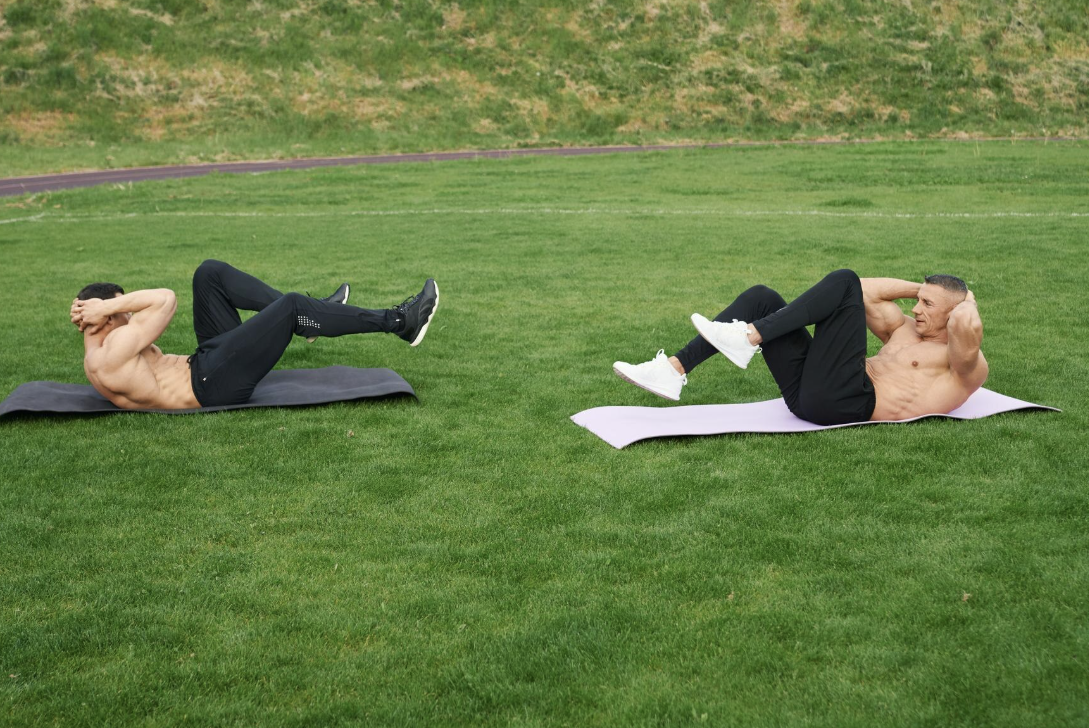
For decades, crunches were treated like the crown jewel of core workouts. Every gym had someone doing them. Every fitness plan had them. And every beginner believed they were the “real” path to tighter abs.
But lately, something interesting is happening.
Across gyms, studios, and even physical therapy rooms, fitness trainers are quietly dropping the classic crunch — and replacing it with a move you might not expect.
And no, it’s not a plank.
Let’s talk about the exercise that’s taking over core training, and why experts believe it might actually reshape the way we train our midsection.
The move replacing crunches: The Standing Anti-Rotation Press
Some call it the Pallof Press, some call it an anti-rotation hold, but trainers agree on one thing:
It challenges your core in a way crunches never could.
Instead of folding your spine forward (like a crunch does), this move trains what your core was truly designed for:
keeping your torso stable while the world around you tries to pull you off balance.
This means your abs aren’t just “squeezing” — they’re defending.
Why the shift? A simple reason trainers can’t ignore
1. Crunches train a movement you rarely use in real life
Think about it:
When was the last time you needed to curl your body forward like a crunch outside the gym?
Your core’s real job is to stop you from twisting, collapsing, or wobbling — not to fold up like a suitcase.
The anti-rotation press does exactly that.
2. Your deep abdominal muscles love this exercise
There’s a layer of muscles under your “six-pack” that crunches barely touch.
But anti-rotation work makes them switch on instantly.
Trainers explain it this way:
“If crunches train the surface, this move trains the wiring underneath.”
3. It teaches your spine how to stay calm under pressure
Most injuries happen when the body rotates suddenly or loses balance.
This move strengthens the muscles that prevent that.
Crunches, meanwhile, only strengthen one motion: bending.
A lesser-known fact: Your brain reads anti-rotation work differently
This is the part most people have never heard before.
When you perform an anti-rotation press, your brain actually treats the task as a stability puzzle rather than a “muscle exercise.”
This activates sensory pathways that crunches don’t trigger — the same pathways your brain uses for balancing on uneven ground or reacting to sudden movement.
This is why people often say:
“I feel more coordinated after doing these, not just stronger.”
If you’ve never experienced that sensation, you’re not alone — most people don’t even know it exists.
The real “I have never read such thing before” moment
Here’s a curious detail even many trainers overlook:
Your core muscles generate more tension when they’re fighting to stay still than when they’re moving.
In other words,
you can create more real strength by resisting motion than by doing a bunch of reps.
It sounds upside down… but your body prefers stability over repetition.
That’s why one anti-rotation hold can fire up your abs more effectively than 20 crunches.
This concept is so counter-intuitive that many people say exactly what you asked for:
“I have never read such thing before.”
So should you stop doing crunches? Not necessarily. But…
Crunches aren’t “wrong.” They’re just incomplete.
If you want a strong, functional, everyday-life-proof core, you need movements that challenge stability.
And this move does that better than almost anything else.
How to try it (simple version)
- Stand tall.
- Hold a resistance band or cable at chest height.
- Step away until there’s tension.
- Press your arms straight out, resisting the band as it tries to pull you sideways.
- Hold. Breathe. Stay tall.
The shake you feel?
That’s your core waking up.
The bottom line
Fitness trainers aren’t ditching crunches because they’re outdated — they’re ditching them because the body works differently than we once believed.
Your core isn’t just a display of visible abs.
It’s a stabilizer, a shock absorber, a balance machine, and your first line of defense when life suddenly pulls you in the wrong direction.
And the anti-rotation press taps into all of that.
It’s simple. It’s smart. And it might just be the most underrated core move in the entire gym.