If you asked people a decade ago what “getting in shape after 30” meant, you’d hear the usual answers — run more, lift heavier, restrict carbs, maybe join a gym you’ll later ignore.
But something unusual is happening now. A new fitness shift is quietly spreading across the country, especially among people in their 30s and 40s who want real-world strength, better recovery, and more energy that actually lasts.
And the best part?
It doesn’t require more hours, more sweat, or a complete lifestyle overhaul.
The Shift: Slow Strength Training
The trend catching attention is something deceptively simple: slow strength training — a method where every movement is performed painfully slow (sometimes 10 seconds up, 10 seconds down).
It sounds too basic to matter, but here’s where it becomes interesting:
- Your muscles respond differently when they’re forced to work under constant tension.
- Strength increases without overloading your joints.
- Workouts become shorter — many people do 15-20 minutes twice a week and still see significant changes.
This is nothing like the “beast mode” workouts pushed on social media.
It’s strength training that’s quiet, intentional, and surprisingly powerful.
Why People Over 30 Love It
People in their 30s start noticing things younger bodies never complain about — stiff ankles in the morning, slower recovery after workouts, and the strange ability to get injured simply by sleeping wrong.
Slow strength training fits perfectly because:
- It protects joints while still building impressive muscle.
- It trains the nervous system, not just muscles — which means more balance and fewer random injuries.
- It boosts metabolism without causing burnout.
- It fits into real life. No 90-minute routines. No extreme diets.
Many call it “the grown-up version of strength training.”
The Lesser-Known Science Behind It
Here’s something most people don’t know:
Your muscles have two main types of fibers — fast-twitch (for power) and slow-twitch (for endurance).
But there’s a third category researchers often mention quietly: intermediate fibers, which can shift depending on how you train.
Slow training pushes these intermediate fibers to become stronger, more fatigue-resistant, and more supportive for everyday movement.
This means you don’t just get strong —
you get strong in the ways that matter when you’re carrying groceries or preventing a fall.
This is the part where people usually say,
“Wait… why did no one teach us this earlier?”
A Strange Discovery: Your Tendons React Faster Than Your Muscles
(This is the “I have never read such a thing before” moment.)
It sounds unbelievable, but studies show that when you slow down your movements, your tendons adapt even faster than your muscles — becoming thicker, more elastic, and more resilient.
That means fewer knee clicks, fewer back “snaps,” and better control in everyday movements.
It’s one of the rare training methods where your connective tissue — often ignored in most workouts — becomes your biggest ally.
The Real Reason This Trend Is Growing
Most trends in fitness come and go.
But this one is sticking because it solves problems that hit after 30:
- Reduced mobility
- Neck and lower back tension
- Slower metabolism
- Shorter energy spans
- Busy schedules that don’t allow long workouts
Slow strength training works with your biology, not against it.
It doesn’t urge you to “push harder.”
It encourages you to move smarter.
How to Try It Today (In the Simplest Way Possible)
You don’t need anything complicated.
Try this once:
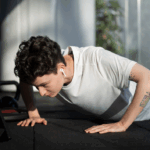
Pick any exercise — a squat, a push-up, or a row.
Now do it so slow that it feels like time has stopped.
- 10 seconds up
- 10 seconds down
- No pause at the top
- Repeat 4–6 times
You’ll feel it — not the burning pain of high-intensity workouts, but a deep, steady strength you didn’t know you had.
A Mini Bonus Tip People Over 30 Rarely Hear
Here’s a small trick physical therapists love:
Pair slow strength with breath-anchored movements.
Example: Inhale deeply as you lower.
Exhale slowly as you rise.
This controls your nervous system, lowers stress hormones, and makes you recover faster — without doing anything extra.
The Bottom Line
Americans over 30 aren’t chasing extreme fitness anymore.
They’re choosing an approach that’s gentle yet transformative, backed by science, and surprisingly efficient.
Slow strength training is not flashy.
But it works — in the ways life after 30 actually needs.
And if there’s one new idea to carry with you, it’s this:
Strength isn’t just about how much you lift.
It’s about how intentionally you move.