
The fitness number that quietly predicts how well — and how long — you may live
For years, health conversations revolved around weight, cholesterol, blood pressure, or step counts. Useful? Yes. Complete? Not quite.
There’s a different number now drawing attention in medical research labs and high-performance gyms alike: VO₂ max. It may sound technical, but its meaning is surprisingly simple — and deeply revealing.
What VO₂ Max Actually Measures (In Plain Words)
VO₂ max stands for maximal oxygen uptake. In simple terms, it tells you how efficiently your body uses oxygen during intense activity.
Oxygen isn’t just for breathing. It fuels every cell. When you move — walk fast, climb stairs, lift weights, chase a child — your muscles demand oxygen. The better your body delivers and uses it, the stronger your internal engine.
Think of VO₂ max as your body’s horsepower rating.
It reflects how well:
- Your lungs pull oxygen in
- Your heart pumps it through your blood
- Your blood vessels distribute it
- Your muscles convert it into energy
That makes it more than a fitness score. It’s a full-system performance test.
Why Experts Are Taking It Seriously
Here’s the part many people don’t realize:
VO₂ max has one of the strongest links to longevity among measurable health markers.
Multiple long-term studies have found that individuals with higher cardiorespiratory fitness levels tend to have significantly lower risks of cardiovascular disease, metabolic disorders, and early mortality.
What makes this remarkable is that VO₂ max often predicts risk independently of body weight. Someone with average weight but low fitness may be at higher risk than someone heavier but aerobically fit.
In other words:
Fitness may matter more than the number on the scale.
It Reflects More Than Just “Being in Shape”
VO₂ max is not only about running marathons.
It quietly mirrors:
- Mitochondrial health (your cells’ energy factories)
- Metabolic flexibility (how well you switch between burning fats and carbs)
- Vascular elasticity (how flexible your blood vessels remain over time)
- Recovery capacity after stress or illness
Because it touches so many systems, researchers sometimes refer to cardiorespiratory fitness as a “vital sign.”
And unlike many lab numbers, it changes meaningfully with lifestyle.
The Age Factor — And Why It Matters
VO₂ max naturally declines with age. That’s normal.
What’s not inevitable is how steep that decline becomes.
Sedentary living accelerates the drop. Regular training slows it. In some cases, people in their 50s and 60s who consistently train can have VO₂ max levels comparable to much younger sedentary adults.
This matters because:
A higher VO₂ max is linked to better resilience — physically and metabolically — as you age.
It may influence how well you tolerate illness, surgery, or physiological stress.
How Is VO₂ Max Measured?
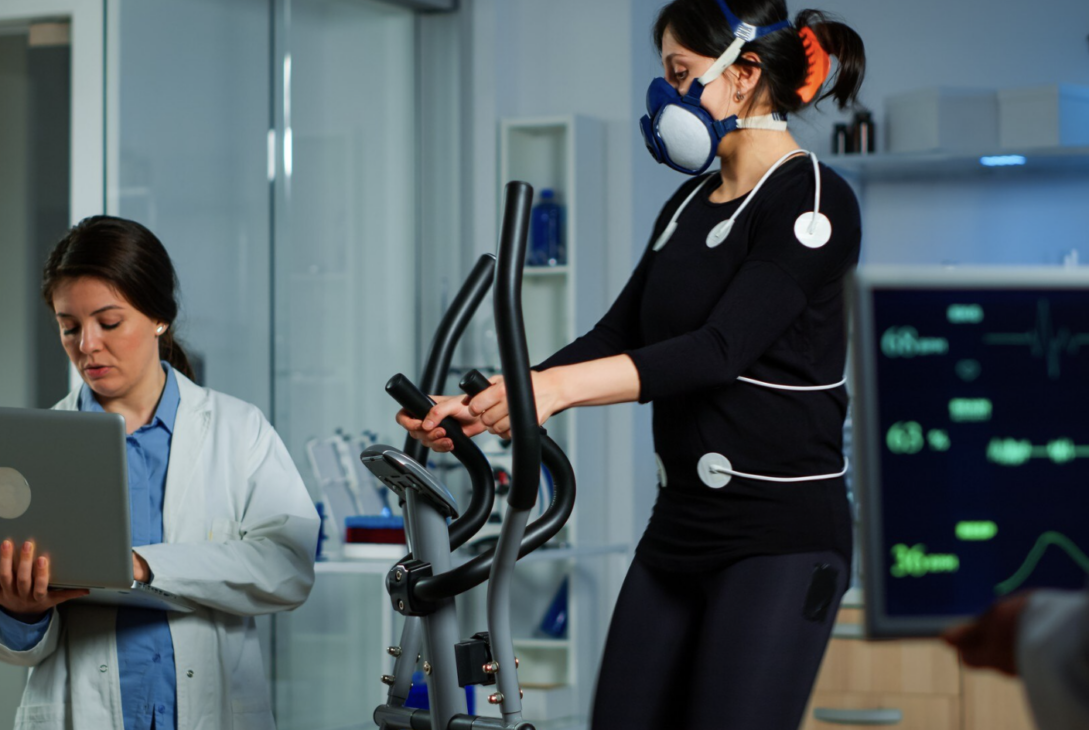
The gold standard test is done in a lab with a mask while exercising on a treadmill or bike.
But today, many wearable devices estimate VO₂ max using heart rate patterns and activity data. While not perfect, they provide useful trends.
What matters most isn’t chasing an elite score.
It’s watching your direction of change.
Is it improving? Staying stable? Declining?
The trend tells a story.
What Most People Get Wrong
Many assume improving VO₂ max requires endless cardio.
That’s incomplete.
Research shows that high-intensity interval training (HIIT) can significantly boost VO₂ max in less time than steady-state cardio. Even short, structured bursts of intense effort can stimulate meaningful adaptation.
At the same time, consistent moderate activity builds the base that supports those gains.
The real formula is often variety, not extremes.
Why This Marker Feels Different
Blood tests show snapshots.
Weight fluctuates.
Step counts can be misleading.
VO₂ max reflects something deeper:
How well your body performs under demand.
It’s dynamic. It responds to effort. It rewards consistency.
And perhaps most importantly, it shifts the focus from appearance to function.
The Bigger Perspective
Health is complex. No single number defines it.
But VO₂ max stands out because it connects movement, metabolism, heart health, aging, and cellular energy into one measurable value.
Instead of asking, “How much do I weigh?”
The more useful question may become:
How strong is my internal engine?
That shift — from aesthetics to capacity — may be why VO₂ max is steadily becoming the health metric people watch most closely.
Not because it’s trendy.
But because it reflects something fundamental:
How well your body is built to live.